

Fairy tales, the oldest and most enduring genre of children’s literature, have historically been viewed as mere cultural artifacts passed down through generations for entertainment. However, contemporary research in developmental psychology, cognitive neuroscience, and pedagogy reveals that these fantastical narratives are far more than simple bedtime stories. They serve as essential developmental scaffolding that shapes a child’s cognitive, emotional, linguistic, and social architecture.
By operating in a safe, metaphorical space, fairy tales allow children to explore complex real-world dynamics before they possess the cognitive maturity to process them directly.
1. Emotional Resilience and Coping with Existential Fears (The Psychoanalytic Perspective)
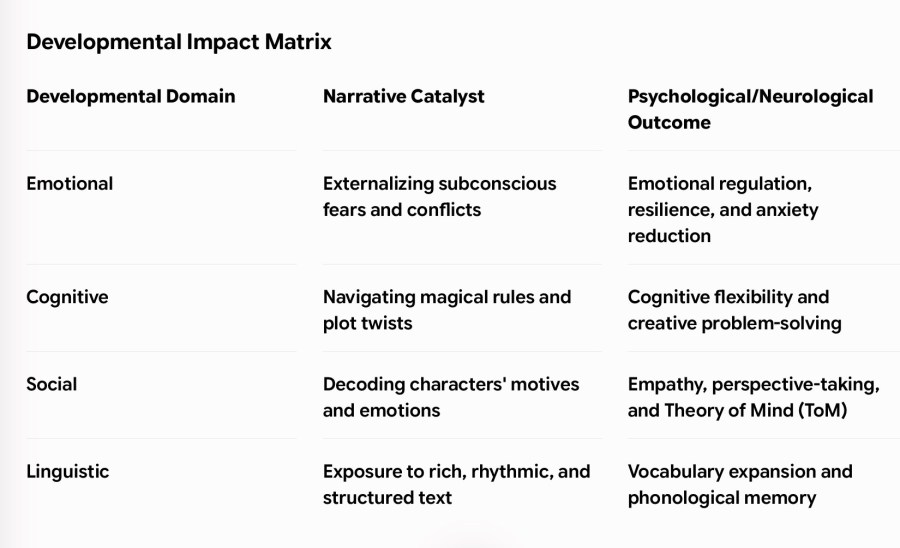
One of the most profound impacts of fairy tales lies in emotional regulation and anxiety reduction. Renowned child psychologist Bruno Bettelheim, in his seminal work The Uses of Enchantment, argued that fairy tales provide a crucial therapeutic medium through which children can externalize and process their subconscious anxieties.
- A Safe Sandbox for Conflict: Monsters, witches, and dark forests represent abstract human struggles—such as abandonment, sibling rivalry, death, and malice—in a concrete, non-threatening form.
- Catharsis and Self-Efficacy: The inevitable “happy ending” in traditional fairy tales acts as an emotional resolution (catharsis). It reassures the child that justice prevails, fosteriung a sense of self-efficacy (the belief that one can overcome life’s obstacles).
Jungian Insight: Analytical psychology emphasizes that the archetypes present in fairy tales (e.g., the wise old mentor, the shadow, the heroic journey) reflect universal human experiences, aiding children in integrating their own developing personalities.
2. Cognitive Flexibility, Executive Functions, and Problem-Solving
Fairy tales challenge the rigid boundaries of realistic thinking, prompting the brain to construct and adapt new mental schemas.
- Cognitive Dissonance and Imagination: Encountering talking animals, magic beans, or flying carpets forces children to process “cognitive dissonance.” Resolving this dissonance stimulates creative imagination and enhances cognitive flexibility—the ability to switch between different concepts or perspectives.
- Logical Analysis and Decision-Making: As the protagonist navigates trials, young listeners actively analyze the plot. They evaluate the consequences of the character’s choices, which strengthens executive functioning and basic cause-and-effect reasoning.
3. Neurolinguistic Development and Early Literacy
The structured yet rich narrative style of fairy tales is highly beneficial for neurological development, particularly in the language centers of the brain (the temporal lobe).
- Lexical and Syntactic Richness: Fairy tales utilize descriptive adjectives, archaic vocabulary, and complex syntactic structures that are rarely heard in daily conversational speech. This exposure expands a child’s semantic network.
- Auditory Attention and Phonological Awareness: The rhythmic patterns, rhyming refrains, and repetitive formulas (e.g., “Mirror, mirror on the wall…”) strengthen the child’s auditory memory and phonological awareness, which are critical precursors to formal reading.
4. Socio-Emotional Development and Theory of Mind
In developmental psychology, Theory of Mind (ToM) refers to the cognitive capacity to attribute mental states—beliefs, intents, desires, emotions, and knowledge—to oneself and others. Fairy tales are highly effective tools for cultivating this skill.
- Perspective-Taking: By stepping into the shoes of diverse characters (from the vulnerable protagonist to the misunderstood sidekick), children learn to view situations from perspectives other than their own.
- Pro-Social Behavior: Fairy tales often highlight virtues like empathy, cooperation, honesty, and perseverance. Seeing these traits lead to positive outcomes encourages children to internalize these moral values and apply them in social interactions.
Practical Takeaways for Parents and Educators (Editor’s Note)
To maximize the developmental benefits of fairy tales, how we share these stories matters:
- Practice Dialogic Reading: Instead of passive listening, engage the child by asking open-ended questions mid-story, such as, “How do you think the character feels right now?” or “What would you do if you reached the fork in the road?”
- Tailor Stories to Developmental Stages: For toddlers (ages 3–4), stick to simpler, repetitive, and reassuring tales. For older children (ages 5+), introduce complex narratives with deeper conflicts to stimulate moral reasoning.
- Utilize Vocal Expression: Modulating tone, pacing, and facial expressions not only maintains attention but also helps children map emotional states to auditory cues, strengthening secure attachment.
Bibliography (Chicago Style)
- Bettelheim, Bruno. 1976. The Uses of Enchantment: The Meaning and Importance of Fairy Tales. New York: Alfred A. Knopf.
- Knox-Johnson, Leilani Visiko. 2016. “The Positive Impacts of Fairy Tales for Children.” Hohonu: Journal of Academic Writing 14: 77-81.
- Mar, Raymond A., Keith Oatley, Jacob Hirsh, Jennifer dela Paz, and Jordan B. Peterson. 2006. “Bookworms versus Nerds: Exposure to Fiction versus Non-Fiction, Divergent Associations with Social Ability, and the Simulation of Fictional Social Worlds.” Journal of Research in Personality 40 (5): 694-712.
- von Franz, Marie-Louise. 1996. The Interpretation of Fairy Tales. Boston: Shambhala Publications.

